on Rennie Ament
on Full-Time Mammal

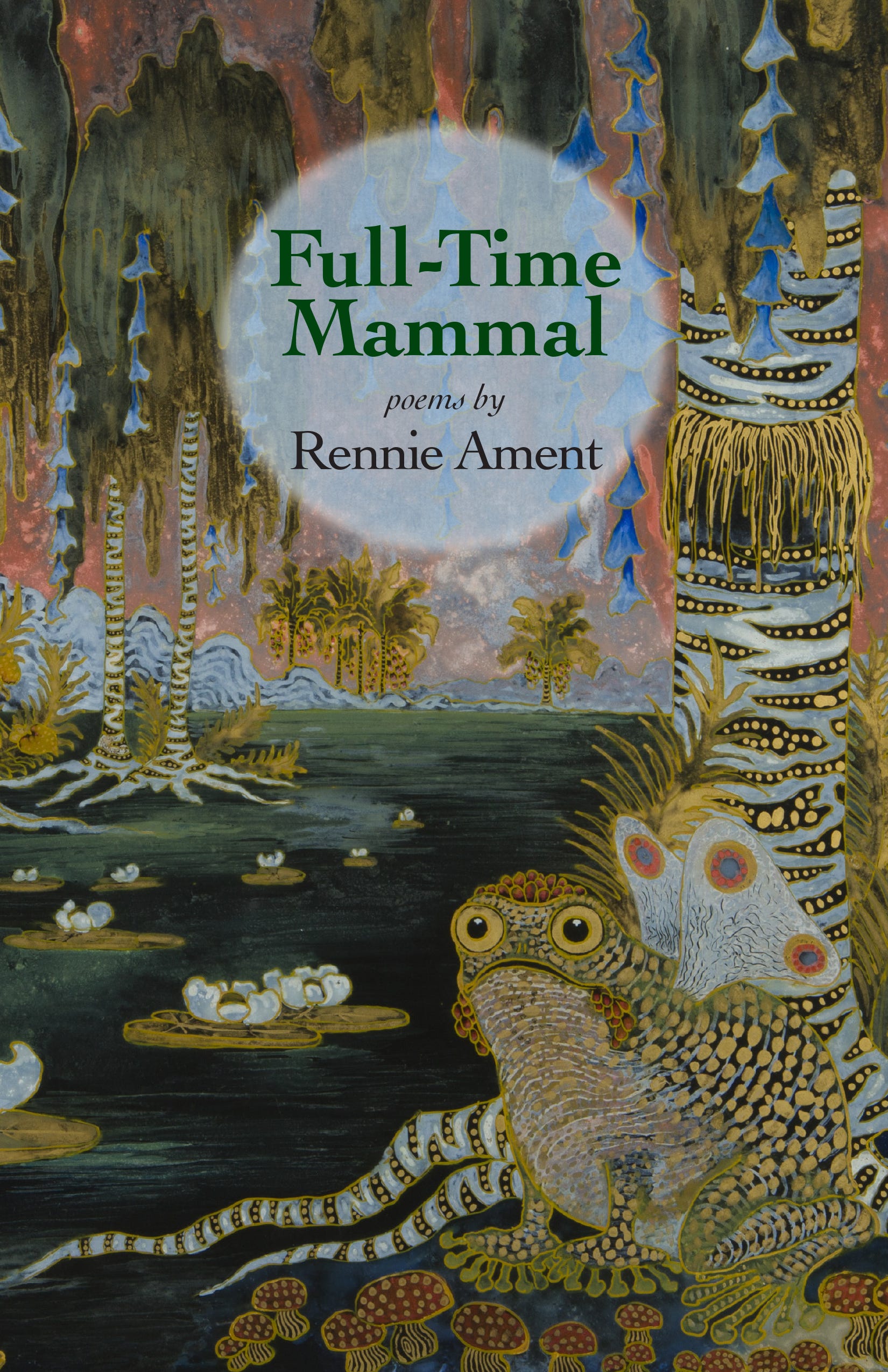
The below is a mini-interview I did with poet Rennie Ament, over her new—brand new—poetry collection Full-Time Mammal; the book comes out today, 4/30/26. I briefly met Rennie amidst the AWP hecticness in Baltimore last month, at the Fonograf Ed. table, and she was kind enough to gift me a review copy of Full-Time Mammal. The volume won the 2025 Iowa Poetry Prize, as selected by Brenda Shaughnessy. It’s an amazing book.
A final note that this year I am a reviewer for Lit Hub‘s 100 Notable Small Press Books 2026 feature, with a focus on poetry and hybrid titles. If you are reading this and are a small press author/publisher with a poetry/hybrid title coming out this year, give me a shout…I would love to read.
****
Tomaž Šalamun
Hi, I’ll compress
the roses further–
what do flowers smell like?
Dogs.
They wag in the wind.
I watch them hump.
Get over here, hands,
it’s January,
the month sprinkled
with jumping mice.
Get over here, mouse.
Jump over my head.
Animals, animals
all thinking, too.
Comma, comma.
Sentence, sentence.
We take a long time to learn
to live with life.
****
JA: One of the things I love in Full-Time Mammal are the jumps; poems “Wipe off the smear of language on the already” (“Porcupine” constantly. Nothing is narrative, everything makes a certain kind of associative sense. How do you know when to shift or jump or is it just intuitive, based on your own sense of where the poem should or shouldn’t go?
RA: It’s intuitive. I can’t premeditate associative sensemaking. In order to make those leaps, I have to take my conscious mind down to its lowest setting and enter a state of…dissociated hyperfocus? It’s a paradoxical mindset, a flow state. I don’t know what to call it. Paul Muldoon, of all people, once gave me a copy of Zen in the Art of Archery. The book (sort of) says, don’t obsess over the target, don’t obsess over your technique, just shoot your arrow a hundred thousand times until you and the bow and the arrow and the target are one.
And I don’t always know if my leaps work, per se. They work for me. But I’m always going to leap too much, too far, and too fast for some readers.
This is an obvious thing to say but knowing when to shift or jump in part comes from reading a lot of poetry written by poets who know when to shift or jump. A long time ago, I read Leaping Poetry, Robert Bly’s short anthology of mostly translated work from poets like Lorca, Transtromer, Vallejo, Rilke, etc. Bly blames Christianity/the Enlightenment/masculinity for pushing poets toward disdain for free association or anything that smells surreal. He calls this trend a destruction of psychic life. Anyway, reading Leaping Poetry led me to read more poetry in translation, and I started to see how so much of what I was reading in English as part of my father-knows-best American Poetry Education was oddly constrained, conservative, and resistant to non-narrative logic in a way that is very much not the norm elsewhere, in other languages. I started reading Shinkichi Takahashi, Han Shan—Buddhist poets, from what I’ve read, are often leaping.
Sometimes I leap away from a thought out of fear, so I do consciously think about whether I’m making an avoidant or redundant horizontal move that doesn’t take the poem deeper. But that’s a retroactive judgment call.
JA: I’m always interested in how poets order their collections. In Full-Time Mammal there are just two sections, of similar length, and there doesn’t seem to be a strict “read this poem, then read that poem 1234” type of order. How did you put the book together?
RA: Gut instinct. It’s a book about learning to trust your gut, so that felt right to me. I did the ordering in a day. The first poem ends with a line about chucking “archaic modes of processing” and the book explodes from there. I’m not positive, but I think if there is an arc it’s this: a mind wakes up from dissociation to find itself trapped in the heart of a nesting doll made of shitty systems. We then move with this mind as it works its way toward respecting its own instincts re what constitutes reality. I’m thinking about authority, hierarchy, assigned roles, identity, naming and classification, who gets to do that naming and classifying—basically, who gets control of the narrative? I’m often talking both in and with nature about all of this. Nature in the comingling, porous, leaky, necropastoral sense of the word.
Maybe the book is also moving towards this unstated conclusion: don’t put energy into buttressing identity—you’ll calcify. I’m way more comfortable saying, “I don’t know who I am exactly. I have a general idea. I am open to being someone else tomorrow if I feel like that someone is an improvement on my current iteration,” etc.
JA: The poem “Tomaž Šalamun” ends with the lines, “We take a long time to learn/ to live with life,” which seems wholly apt—and haunting. Why the title for that poem? I assume because Šalamun was an influence, but perhaps I am being didactic…
RA: It’s called “Tomaž Šalamun” because I realized after I wrote it that my lines (“what do flowers smell like? / dogs”) are an inversion of lines from Šalamun’s “Jonah” (“how do little dogs play? / like flowers”). I should’ve made a note in the book that mentions this!
Šalamun is big for me, yeah. His poems are playful, a little feral. They leap. They’re subversive and volatile. He doesn’t settle into a mode. He’ll write poems in simple, straightforward language; he’ll write poems that land as Language poetry. His “I” shifts; sometimes it’s autobiographical, sometimes it’s open. I can’t prove this, but based on the number of books he published (50+?) I think he wrote constantly and kept himself, as much as possible, in a flow state (“listen to the flow” as he writes in “Jonah”), which I try my best to do, too. There’s a mystical edge to him. I feel religious in the vein of “Ships,” too: “I’m religious. / As religious as the wind or scissors.”
****
Bright Green Lens
When I die it will be from a lack of tenderness.
Place my bones in a hollow tree
to be a bird’s nest foundation. Writing this
brings me close to animals, and the rote
animal in me that is afraid. It’s good
to say blunt things. It’s ok to die at times—
later, by a surplus of some cells.
But I’m here now foraging words,
acorns to squirrel away. Cruciferous,
delicious, I mizuna the thought,
kohlrabi the day. I garden the I so it will stay
hedged in. Planimal or minimal, I steal
genetic material. When I live it will be
through a bright green lens.
****
JA: There are so many great, enticing lines in the book, from “I dad the eternal hole of life” (“You Know What I Mean” to “Regret papers the rock of the world” (“I Ching Sunset”). I’m curious what your revision process is like—do you find lines like those in revision or do they pop out while writing a first draft? Or something else entirely?
RA: Most of these poems were written in short windows of time in the morning before I went to my dumb retail job. I almost see the book as durational performance art. So there wasn’t much revision; these specific poems just weren’t meant for it, I think. I’m not interested in being their master. I tweaked some of them, but nothing big. I’m working on a new book, and I can tell I’m gonna revise this one ad nauseum. So, you never know how it will go.
In terms of the phrasemaking itself–that’s just how my brain works. Wires are crossed and the phrases pop out as I go. Sometimes I’ll take phrases from abandoned poems and drop them into new poems to see if they work. Or if I get stuck while writing, I’ll pick up a random book and read until I hit a word that triggers a phrase in my head.
I bet “I dad the eternal hole of life” owes something to Francine Harris’s poem “enough food and a mom,” which ends, “I mom of you. I mom of you a lot.” Or Layli Long Soldier’s poem “Edge” which has a line that goes, “I Mommy the edge.” I like when nouns verb in poems.
JA: What do you wish was different about the poetry world? What do you really like or enjoy?
RA: My complaints are pretty standard. Private equity. Racism. Nepotism. Patriarchy. Pick your poison and you can find it at the institutional heart of the poetry world. I wish that the poetry world was set apart from the world at large, but it isn’t. I wish experimental poetry counted as Real Poetry in the minds of more of the people who dole out the limited number of funded poetry opportunities.
I enjoy the small press ecosystem. The people who run those presses, the poets who publish with those presses: everyone is working so hard for little to no money or attention. And they’re usually smart. And they’re usually fun. And they usually take what they’re doing seriously without being self-serious.
The fringe should be at the center, and the center should be at the fringe, but then the fringe wouldn’t be the fringe. I think you have to experience a little, if not total, rejection by culture at large, if you’re going to have anything relevant to say about said culture? About reality, in general.
I used to work as a bookstore manager for a supposedly indie chain bookstore and was horrified the first time I saw how the ordering process worked. I hadn’t really understood that sales are in so many ways predetermined. Stores are presented with a tightly curated frontlist. Big Five reps tell stores which books, how many copies. If you order thirty copies of a book, you’re going to feature that book prominently. Hello Sunshine, Reese Witherspoon’s (and Blackstone’s) media company runs Reese’s Book Club, which selects easy books with clear narratives (women’s stories specifically, so shut up and love it, this is feminism!) that Hello Sunshine can adapt for film or TV. Barnes & Noble has a contract with RBC that involves heavy promotion of the books. It’s a closed system. It’s all shades of Hello Sunshine. And poetry has no role because it can’t compete with the profits to be made on something like Where the Crawdads Sing. What would have to happen to poetry to make it profitable and thus worthy of distribution in this system? Nothing good.
****
I Ching Sunset
At the foot of a mountain leaning
with magnifying glass
over prostrate dense patches
of common chickweed. Closeup,
green subordinates itself
to a hairy-leg texture.
Disturbed areas radiate
weed treasuries quickly.
A carrot-colored cloud
controls the scene;
everything is wick and burns.
That’s why I set off cold,
never know when a season may
not come to its senses.
Smell it, the single-celled scent.
Regret papers the rock of the world.
There are too many types of knots
being converted to people.
Some will die in denial.
Some will die in September.
Some will live and be orphans.
After a matter has been pondered
form a decision and act
or haunt your pocket of black.
****
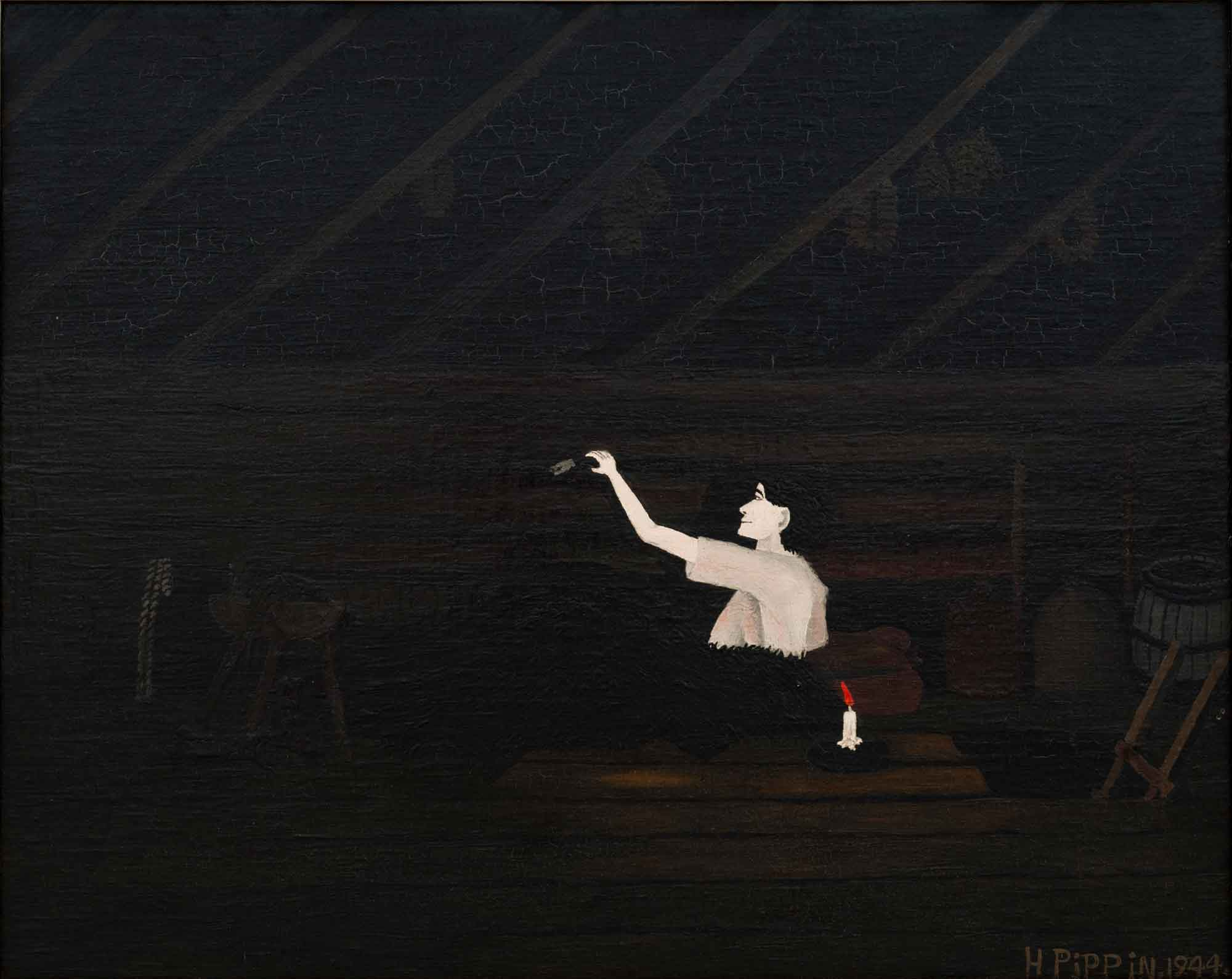
Horace Pippin
Abe Lincoln’s First Book
1944